
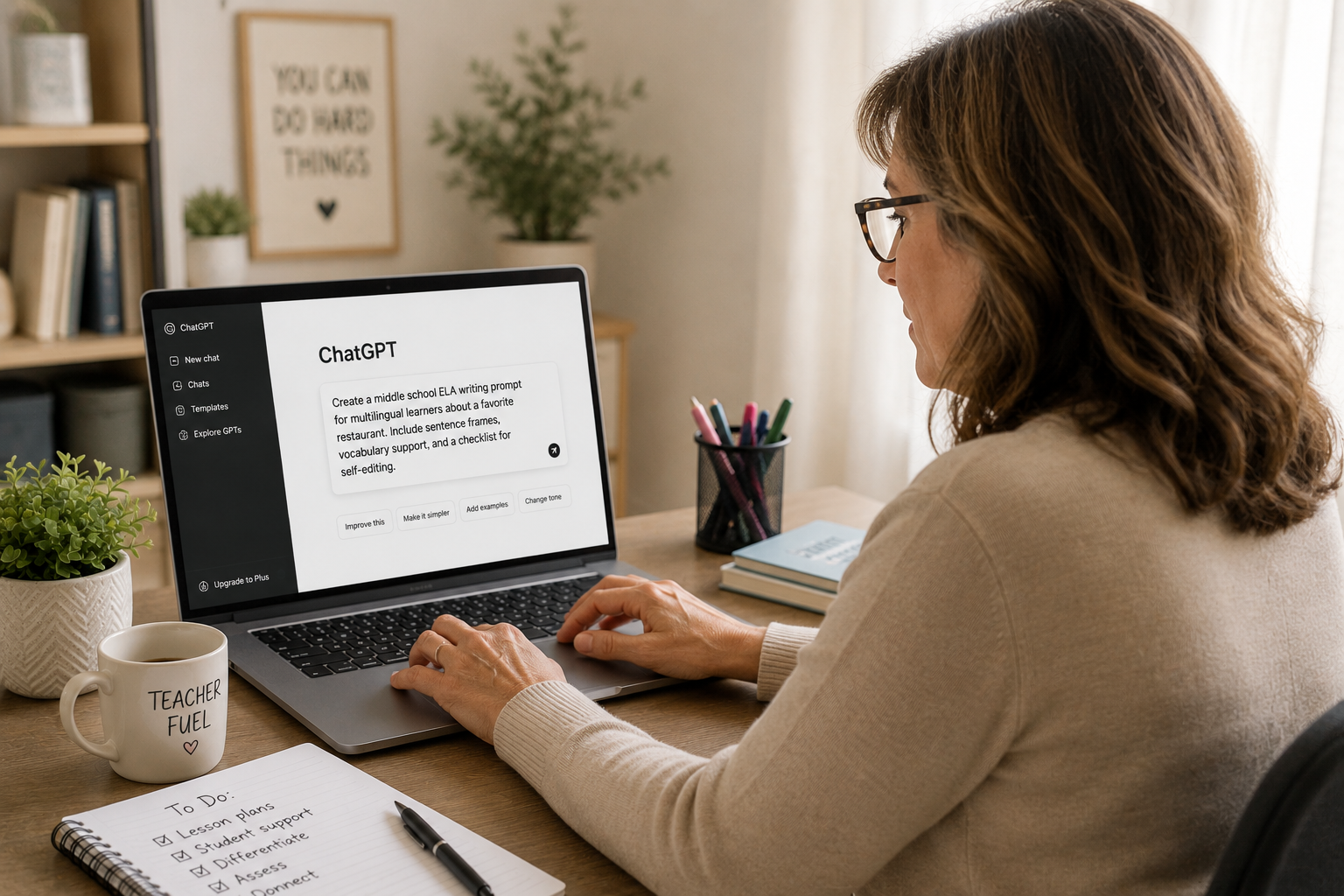

I use AI in my own work.
It helps me get past the blank page, organize ideas, revise directions, generate possibilities, and complete some of the tasks that would otherwise take much longer.
I also know how easily AI can produce something that sounds polished but is inaccurate, generic, repetitive, or completely unlike me.
That is why I do not think the most useful question is whether teachers are “cheating” when they use AI.
A better question is:
What is the teacher doing with what AI produces?
AI can help with the work, but it cannot take responsibility for the finished product. That responsibility still belongs to the teacher.
Why Teachers Are Using AI
Teachers are expected to plan instruction, differentiate materials, support multilingual learners, meet IEP and 504 requirements, assess student progress, communicate with families, document interventions, attend meetings, and respond when the plan falls apart in the middle of class.
There is rarely enough time built into the school day to do all of that well.
It makes sense that teachers are experimenting with AI tools to help with tasks such as:
- Brainstorming lesson ideas
- Drafting discussion questions
- Revising directions
- Generating examples
- Creating sentence frames
- Adjusting reading passages
- Organizing information
- Producing a starting point for a rubric or graphic organizer
Using a tool to reduce drafting time is not automatically unprofessional.
Submitting the first response it generates without reviewing it is another matter.
AI Is More Than a Digital Template
Teachers have always used curriculum guides, curriculum guides, colleague-created materials, online resources, templates, and commercially produced lessons.
AI overlaps with those tools, but it is not exactly the same.
A template stays the same until a person changes it. AI produces new content in response to a prompt, and that content can sound confident even when it is wrong.
It may:
- Invent facts or sources
- Misrepresent a standard
- Create examples that do not make sense
- Oversimplify a concept
- Use language that is inappropriate for the grade level
- Repeat stereotypes or biased assumptions
- Claim that a strategy is research-based without providing reliable evidence
- Manufacture classroom stories or student reactions
- Produce writing that sounds polished but says very little
That means using AI responsibly requires more than adding a teacher’s name to the top of the page.
AI Does Not Know the Students
An AI tool does not know which student becomes overwhelmed by a page filled with text.
It does not know who understands the science concept but lacks the English to explain it. It does not know which sentence frame has become a crutch, which student needs a model, or when a student is ready for less support.
It also does not know the history of the class, the pacing of the curriculum, or what happened during yesterday’s lesson.
A teacher can provide some of that context in a prompt, but professional judgment is still needed to decide whether the output is useful.
AI may suggest a scaffold. The teacher must determine whether that scaffold addresses the actual barrier.
The First Draft Is Not the Finished Work
One of the most useful things AI can do is provide a starting point.
Starting with a draft can be easier than staring at a blank document, especially when the teacher already knows the goal but needs help organizing the material.
The problem comes when a first draft is mistaken for a finished product.
AI-generated materials often need substantial editing. A teacher may need to:
- Correct factual errors
- Remove unnecessary language
- Replace weak or confusing examples
- Check the reading level
- Verify standards and sources
- Adjust the task for the actual class
- Add or remove scaffolds
- Correct answer keys
- Make directions more precise
- Remove claims that are unsupported
- Rewrite the material so it sounds like a teacher rather than a machine
Sometimes AI saves time. Sometimes checking and correcting the output takes longer than creating the material independently would have.
Both can be true.
Differentiation Still Requires Professional Judgment
AI can quickly produce multiple versions of a passage, question, or assignment.
That does not mean every version is appropriately differentiated.
Simplifying a text may remove the content students need. A sentence frame may complete too much of the thinking. A “challenging” version may only use longer words rather than require deeper reasoning.
Teachers still need to ask:
- Does this version preserve the learning goal?
- Is the student receiving access or a different assignment?
- Does the scaffold support the barrier?
- Is the language clear without becoming inaccurate?
- Can the support be reduced as the student becomes more independent?
Generating three versions is easy. Designing three useful access points is not.
Student Privacy Is Not Optional
Teachers should never enter personally identifiable student information into an AI tool unless the school or district has explicitly approved that use and the platform meets applicable privacy requirements.
That includes information such as:
- Student names
- IEP or 504 details
- Disability information
- Behavior records
- Assessment results connected to a student
- Family information
- Medical information
- Personally identifiable writing samples
A teacher can describe a general instructional need without identifying the student.
For example, ask for sentence frames for a middle school multilingual learner developing English proficiency. Do not paste a student’s records into a public AI platform and ask it to design an intervention.
Teachers should also follow their school or district’s current policies. Acceptable use can vary by platform and district.
My Test for AI-Generated Materials
Before using anything created with AI, I would ask:
- Is it accurate?
- Does it align with the actual learning goal?
- Is it appropriate for these students?
- Have I verified any standards, facts, quotations, or sources?
- Does it preserve appropriate rigor?
- Does it protect student privacy?
- Can I explain and defend every part of it?
- Does the finished material reflect my professional judgment?
If I cannot answer those questions, the material is not ready for students.
What AI Cannot Do for Me
AI can suggest questions, but it cannot watch students respond to them.
It can draft a graphic organizer, but it cannot see whether the organizer clarifies the task or adds another layer of confusion.
It can create a lesson plan, but it cannot notice when students need more processing time, a different example, or permission to sit in the struggle before receiving help.
Those decisions happen in the classroom.
Teaching is not simply producing materials. It is knowing when and how to use them.
So, Is Using AI Cheating?
I do not believe teachers are cheating simply because they use AI to brainstorm, draft, revise, or organize their work.
I also do not believe that every use of AI is responsible just because a teacher is busy.
There is a meaningful difference between using AI as a starting point and allowing it to make instructional decisions without review. There is also a difference between saving time and handing over professional responsibility.
Teachers should be honest with themselves about how much of the thinking they are doing, how carefully they are reviewing the output, and whether the final work truly serves their students.
Final Thoughts
AI can reduce some of the mechanical work involved in planning and creating classroom materials. That can leave teachers with more time for instruction, feedback, collaboration, and responding to students.
But that outcome is not automatic.
AI only saves meaningful time when the material is accurate, appropriate, and carefully reviewed. The teacher still has to bring the knowledge of the students, the content, and the classroom.
Using AI is not the problem.
Using it without judgment is.
Leave a Reply