
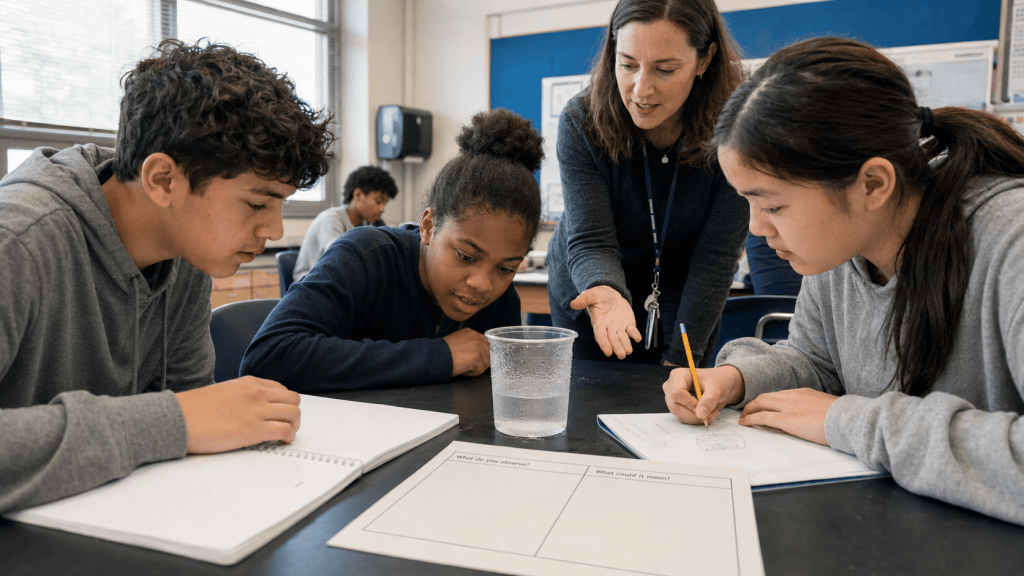
Have you ever asked students to explain a scientific phenomenon only to realize they hadn’t really spent time observing it?
I’ve done it.
Sometimes we ask students to explain before they’ve had the chance to notice, to infer before they’ve gathered evidence or to write before they have something meaningful to say.
But careful observation is one of the foundations of scientific thinking.
Before students can develop strong explanations, they need time to notice what is happening, identify patterns, and gather specific evidence.
Observation Gives Students Something to Explain
Scientific investigations do not always follow one predictable sequence. Scientists may begin with a question, an existing model, prior knowledge, an unexpected result, or something they observe.
But observation remains an essential part of the process.
Scientists pay attention to changes and patterns. They collect information, ask questions, compare evidence, and revise their thinking as they learn more.
Our classrooms should give students opportunities to do the same.
When students spend time observing a phenomenon before hearing the explanation, they have something concrete to think about. They can begin asking questions based on what they actually noticed rather than trying to guess what the teacher wants them to say.
Why Students Struggle With CER
Writing strong claims, evidence, and reasoning is a common challenge in middle school science.
We often treat this as a writing problem. Sometimes it is. Students may need support organizing their ideas or using academic language.
But sometimes the problem begins earlier.
Students may not have gathered enough specific evidence to support their thinking.
If they have not carefully examined a phenomenon, model, demonstration, or set of data, their evidence may remain vague:
It changed.
The graph went up.
Something happened to the water.
Vague evidence gives students very little to reason from. When students slow down and record exactly what they notice, they are better prepared to develop a claim and explain how their evidence supports it.
In many ways, observation is the invisible first step of CER.
Observation Is Not the Same as Inference
Students often think they are recording an observation when they are actually making an inference.
An observation describes what they notice or measure:
The clear liquid became cloudy after the two substances were combined.
An inference explains what they think that observation might mean:
A new substance may have formed.
Both are important, but they serve different purposes.
When students jump immediately to an inference, they may treat their conclusion as if it were evidence. Helping them separate what they noticed from what they think it means makes their scientific explanations clearer.
A simple two-column chart can help:
| What I Notice | What I Think It Might Mean |
|---|---|
| The outside of the cold container is covered with small drops of water. | Water vapor in the air may have cooled and condensed. |
| The temperature decreased by 4°C. | The process may have absorbed thermal energy. |
Students are still responsible for making sense of the evidence. The chart simply makes the difference between observation and interpretation visible.
Slow Students Down Before Asking Them to Explain
Instead of beginning with, “What does this show?” give students time to collect information first.
Ask:
- What do you notice?
- What patterns do you see?
- What changed?
- What stayed the same?
- What surprises you?
- What can you measure or describe specifically?
Imagine students are observing condensation form on the outside of a cold container.
If we begin by asking, “Where did the water come from?” students may immediately start guessing. Some may say the water leaked through the container. Others may repeat an explanation they remember hearing before.
Instead, students could first record what they actually see:
- The outside of the container was dry at the beginning.
- Small drops appeared on the outside after several minutes.
- More drops formed near the coldest part of the container.
- The water inside the container was colored, but the drops outside were clear.
These observations give students something meaningful to discuss. They can compare ideas, consider which explanations fit the evidence, and identify questions they still need to investigate.
The explanation comes later after there is evidence to explain.
A Simple Routine for Teaching Observation Skills in Science
You do not need an elaborate lab to build observation skills in science. Students can practice with a close up photograph, a short phenomenon video, a diagram, a model, an everyday object, a demonstration, a weather map, a graph, or a data table.
Try this simple routine:
- Observe silently. Give students uninterrupted time to examine the phenomenon without explaining it for them.
- Record observations. Students write, sketch, label, measure, or organize what they notice in a chart.
- Compare with a partner. Students share observations and add details they may have missed.
- Separate observation from inference. Ask students to identify what they directly noticed and what they think it might mean.
- Develop a question or explanation. Students use their observations to begin making sense of the phenomenon.
The routine can take only a few minutes, but it changes the order of the thinking. Students gather information before being asked to interpret it.
Resist the urge to give the answer too quickly.
The thinking begins in the noticing and deepens as students connect observations, recognize patterns, and consider possible explanations.
Observation Creates an Accessible Entry Point
Observation also gives more students a way into the lesson.
Students do not all need to begin with a complete verbal explanation. They can record what they notice using words, labeled sketches, measurements, or a simple chart before they are asked to use more complex academic language.
This can be especially helpful for multilingual learners, students who need additional processing time, and students who understand the phenomenon but are not yet ready to explain it in a full paragraph.
A sentence frame such as “I noticed ___ changed when ___” can support language production without telling students what to observe or what conclusion to reach.
The scientific thinking remains with the student.
The support simply removes an unnecessary language barrier so the student can communicate that thinking.
Stronger Observations Lead to Stronger Explanations
Once students have gathered rich, specific observations, CER writing becomes more manageable.
Their claim responds to a phenomenon they have examined.
Their evidence includes details they noticed, measured, or found in the data.
Their reasoning explains how that evidence supports the claim using scientific ideas.
Observation alone will not solve every difficulty students experience with CER. They may still need instruction in selecting relevant evidence, applying scientific concepts, and explaining the connection between evidence and a claim.
But without careful observation, students may have very little to work with.
Sometimes we ask students to explain before we have given them enough time to observe.
Slowing down doesn’t slow learning.
It deepens it.
When students learn to observe carefully, they ask better questions, gather stronger evidence, and develop explanations rooted in what they actually notice.
That is how we help students begin thinking like scientists.
🌿 The Faodail Reflection
Scientists don’t simply memorize the world.
They observe it.
Then they work to make sense of it.
Leave a Reply