
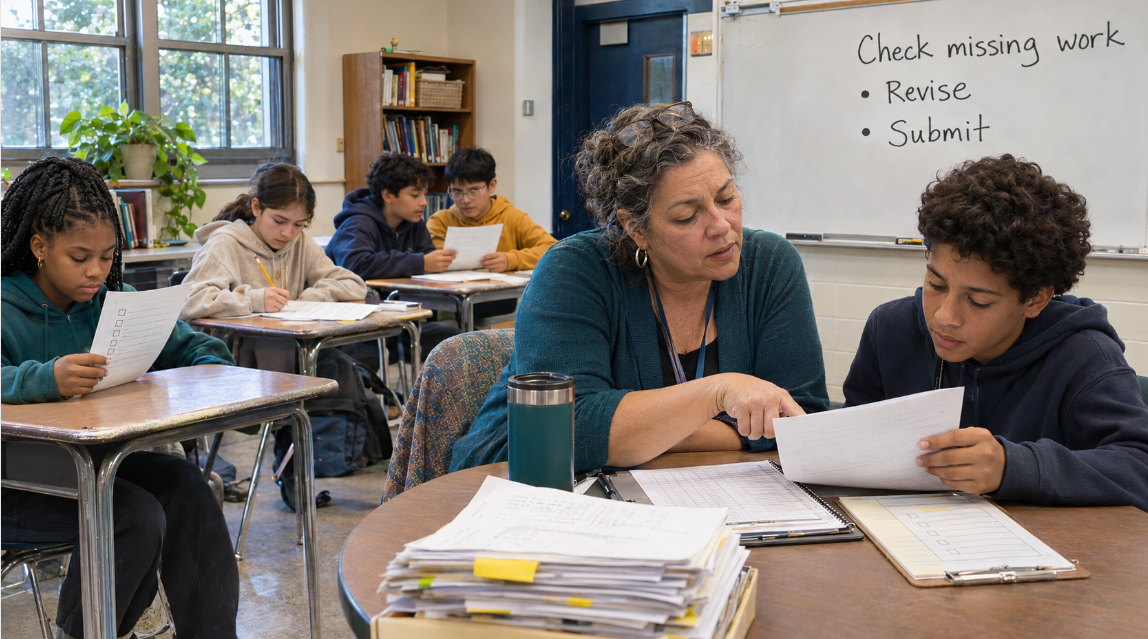

There is a particular kind of frustration that settles in at the end of a grading term.
You are reviewing missing assignments, updating grades, and trying to give students one more opportunity to show what they know. You send emails. You message families through the school app. You include reminders in weekly announcements. You invite parents and caregivers to conferences.
And sometimes, you hear nothing.
The messages remain unread. The missing work remains missing. Parent-teacher conferences come and go, and the families you most hoped to see do not attend. Meanwhile, some students seem just as unconcerned about the approaching deadline.
Then comes the question from administration: What have you done to reach the family?
It can feel like pushing a boulder uphill—and being asked why you have not moved it faster.
The Invisible Work Behind Report Cards
A report card may show a letter, number, or standards-based score, but it does not show everything that happened before that grade was entered.
It does not show the assignment posted in more than one place, the verbal reminders, the extra copy handed to a student, or the time provided in class. It does not show the email, the app notification, the weekly family update, the conference invitation, or the follow-up message.
It does not show the conversations that sound like:
“You still have time to complete this.”
“What is getting in your way?”
“Let’s decide which assignment you should finish first.”
Teachers are often asked to provide evidence that they communicated, reminded, encouraged, offered support, and followed up. Some of that accountability is reasonable. Families should not be surprised by a report card, and students deserve meaningful opportunities to recover from a difficult start.
But communication is not the same as engagement.
A teacher can open the door. We cannot make another person walk through it.
When Responsibility Quietly Becomes Unlimited
The most exhausting part of the end of the term is not always the grading itself. It is the feeling that the teacher remains responsible for every part of the process, including the parts we cannot control.
We are responsible for making expectations clear. We are responsible for creating accessible assignments, providing feedback, offering reasonable support, communicating concerns, and documenting our outreach.
We are not able to control whether every message is opened, whether every conference is attended, or whether every student chooses to use the opportunities provided.
That distinction matters.
Without it, teachers can begin to believe that one more email, one more reminder, or one more extension will finally produce the response they have been working toward. Sometimes it does. Sometimes it does not.
Both things can be true: a family may have real barriers that prevent participation, and a teacher may have already made repeated, good-faith efforts to connect.
Recognizing the first truth should not require us to ignore the second.
The Hardest Part: Keeping Frustration Away From Students
When students appear apathetic about missing work, it is difficult not to take that personally. We have spent hours planning, teaching, conferencing, modifying, reteaching, and responding. Their lack of urgency can feel like a lack of respect for all of that effort.
But frustration is not a useful teaching strategy.
The student sitting in front of us may be overwhelmed, embarrassed, disorganized, discouraged, or unsure where to begin. A student may also be making a choice not to complete the work. We do not have to pretend that choices do not have consequences, but we can respond without turning our frustration into shame.
Instead of another general warning to “catch up,” a student may need a smaller, concrete next step:
- Choose the one assignment that will best show your learning.
- Open it now and complete the first question.
- Use this checklist to identify what is unfinished.
- Attend one scheduled help session before the deadline.
- Tell me whether you need clarification, time, or a fresh copy.
These supports remove confusion without removing responsibility. The student still has to do the thinking and complete the work.
What Teachers Can Do Without Taking On Everything
At the end of the term, I need a process that is clear enough for families and students—but also sustainable for me.
Keep a simple communication record
Document the date, method, and general reason for each contact. The goal is not to build a case against a family. It is to create an accurate record of the support and communication already provided.
Send one clear end-of-term message
Instead of sending several increasingly urgent reminders, send a concise message that includes:
- the final deadline;
- where missing work can be found;
- which work can still be submitted;
- when help is available; and
- what will happen if the work is not completed.
Clear communication is more useful than repeated communication that becomes easier to ignore.
Prioritize evidence of learning
When time is short, not every missing paper carries equal instructional value. Identify the assignments that provide the clearest evidence of the standards students were expected to learn. This does not mean giving away points or lowering expectations. It means focusing limited time on the work that matters most.
Offer structured choices
“Complete all your missing work” can feel impossible to a student with a long list. “Choose one of these two assignments and begin today” creates a manageable entry point while preserving student responsibility.
Decide what completion looks like for you
There comes a point when the grade must reflect the evidence available. If expectations were clear, access was provided, support was offered, and concerns were communicated, entering the grade is not giving up on a student. It is reporting what the student demonstrated during that term.
There Is Barely Time to Recover Before Testing Begins
The end-of-term push rarely leads into a quiet stretch. Once the holidays are over, testing season is already beginning or close behind.
In Massachusetts, many multilingual learner teachers and students move into ACCESS for ELLs testing in January. MCAS begins not long after, with preparations intensifying well before the first test session in the spring.
The same teachers who are closing grades, documenting family outreach, and trying to reengage students are also preparing accommodations, reviewing data, adjusting instruction, and helping students face the next high-pressure demand.
There is very little space to pause.
That is why protecting our energy at the end of a term is not selfish. It is necessary. We cannot begin every new grading period or testing cycle depleted by trying to control responses that were never fully within our control.
We Can Care Deeply Without Carrying Every Outcome
Teachers should communicate. We should make learning accessible, provide meaningful support, and continue looking for ways to connect with families. We should also examine whether our systems are understandable and whether language, technology, work schedules, transportation, or past experiences with school are creating barriers.
But family engagement is a shared responsibility. Student effort is a shared responsibility. A teacher’s responsibility cannot expand until it includes every action another person chooses—or does not choose—to take.
At the end of the term, I want to be able to ask myself:
- Were my expectations clear?
- Did students have access to the work and the support needed to complete it?
- Did I communicate concerns before the final grade?
- Did I provide a reasonable path forward?
- Does the grade honestly reflect the evidence I have?
If the answer is yes, then I have done my part—even when the outcome is not the one I hoped for.
Sometimes the boulder does not reach the top of the hill.
That does not mean the teacher was not pushing.
Leave a Reply